Society
Who’s Winning the 21st Century? China vs USA vs India in Hard Numbers
On this auspicious day of Ganesh Chaturthi, India is out here blasting speakers, dunking idols and turning rivers into soup, while China known as 'the country of atheists' is just quietly manufacturing the entire planet and racing the USA in tech. One country’s busy with gods and noise, the other is busy with science and world domination. Guess who skipped the festival and still ended up winning? 😏
The real race
Every few years we Indians get excited. Someone declares that India is the next superpower, the world’s fastest-growing economy, the future of the planet. We forward the WhatsApp forwards, change our display pictures, and feel proud for approximately 48 hours.
Meanwhile, two countries are actually competing for the 21st century.
The United States still sits on the biggest economic and military chair. China has spent the last three decades quietly building factories, high-speed trains, patents, and influence like a student who never skips class. And India? We’re the enthusiastic classmate sitting in the third row, waving our hand, shouting “Sir, I also have potential!” while still looking for our notebook.
And of course, while America and China were busy with semiconductors, research labs, and bullet trains, a large section of us remained deeply invested in the far more productive national project of deciding which god is superior, which ritual will fix the economy, and whether drinking cow urine counts as innovation. Nothing says “21st century superpower” quite like treating science as optional and superstition as compulsory.
As if that wasn’t enough, we also found time for other high-priority national debates: which language is the oldest and purest, which state is clearly superior to all others, and whose caste has the most glorious history. While other nations were filing patents and building infrastructure, we were busy writing long Facebook essays proving that our mother tongue existed before the Big Bang, that our state invented civilisation, and that our caste produced every great person who ever lived. The rest of the world is racing for the future. We’re still fighting over who came first in the past.
This article is not another motivational speech. It’s a simple, number-based reality check. We’ll put China, America, and India side by side on economy, military, technology, and quality of life — and see who’s actually leading, who’s catching up, and who’s still busy taking selfies at the starting line.
No feelings. Just hard numbers. Let’s begin.
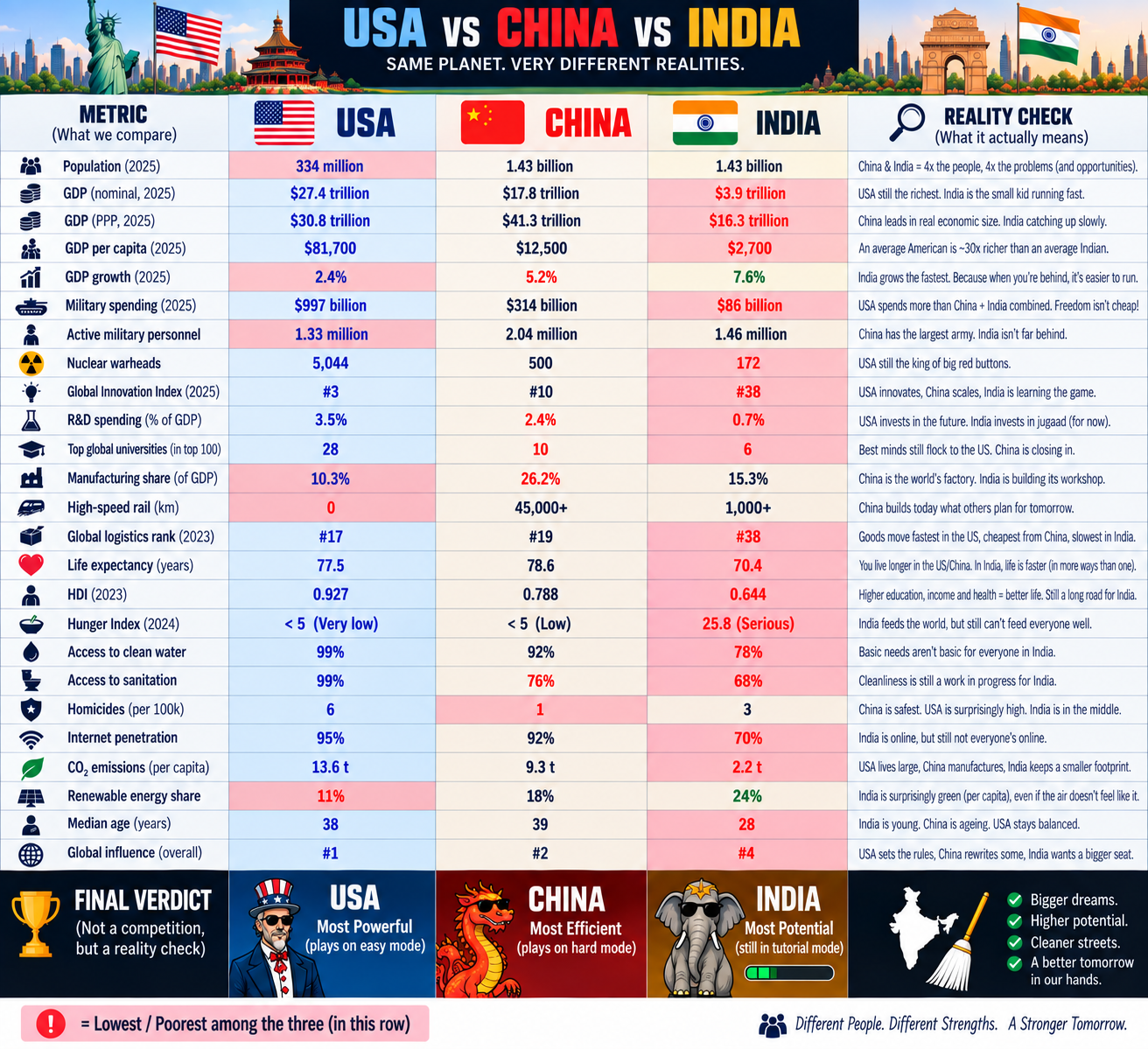
Hard numbers
USA can fight two wars at once. China can build ships faster than most countries can approve budgets. India can write the longest strategic vision documents and still need to import critical weapons.
USA invents the future. China copies it at industrial scale and then improves it. India invents the term “jugaad” and then acts surprised when jugaad doesn’t produce semiconductor fabs or AI models that lead the world.
China lays high-speed rail like it’s laying carpet. USA already has world-class systems. India holds the global record for the longest-running “project under implementation.”
USA scores high on quality of life. China dramatically reduced poverty and hunger. India ranks world-class in the number of people who believe rankings don’t matter because “we have culture.”
The final scoreboard: Two countries are playing in the Champions League of the 21st century. One country is still in the dressing room, arguing about the team song, the colour of the jersey, whose grandfather was the best player in 3000 BCE, and whether the coach should be replaced by a god.
India’s biggest competitive advantage remains its unmatched ability to feel proud about future achievements that haven’t happened yet.
How China Actually Became a Superpower (The No-Nonsense Version)
They never fully lost the country
In 1949 they got one strong boss who actually controlled the whole place
In 1978 they kept the strong boss but switched on capitalism
They used their huge population as workers, not just as voters or devotees
They copied technology at industrial scale and built everything fast
Result: From getting humiliated in the Opium Wars to becoming a superpower.
Meanwhile in India…
While China was busy with Special Economic Zones and high-speed rail, we were busy with Special Spiritual Zones and high-speed aarti.
Their formula was “authoritarian politics + market economics.”
Our unofficial formula has often been “democracy + divine intervention.”
They forced giant projects through.
We force giant yagnas through and then wait for the results.
They treated population as a workforce.
We treat population as a ready-made audience for religious processions and WhatsApp forwards about miracles.
China turned humiliation into industrial power.
We turned ancient glory into an unlimited excuse for why the present still looks under-construction.
The Final Reality Check
After all the numbers, there is one slightly uncomfortable conclusion: America is already playing the game, China is playing to win it, and India is still arguing about whose ancestor invented the game.
We have the talent, population, economy, scientists, engineers, entrepreneurs and, apparently, unlimited confidence in our future greatness. Sometimes, however, our greatest national achievement is celebrating tomorrow while ignoring today.
We want world-class cities but litter the streets. We demand better infrastructure but ignore traffic rules. We complain about corruption but occasionally ask, “Can you do it without a receipt?” We celebrate science while forwarding miracle cures on WhatsApp. And somehow, every problem becomes someone else's responsibility.
That’s the satire. Not India. Us.
India doesn't lack potential. It lacks the consistent civic discipline needed to convert that potential into reality.
So this comparison isn't about proving that America or China is “better” than India. It's a mirror—not a scoreboard.
If these numbers make us uncomfortable, good.
Maybe the next Indian superpower won't be another motivational quote, a GDP prediction, or a patriotic WhatsApp status.
Maybe it will simply be millions of citizens deciding to do the right thing when nobody is watching.
Because building a better India isn't someone else's job.
It's ours.